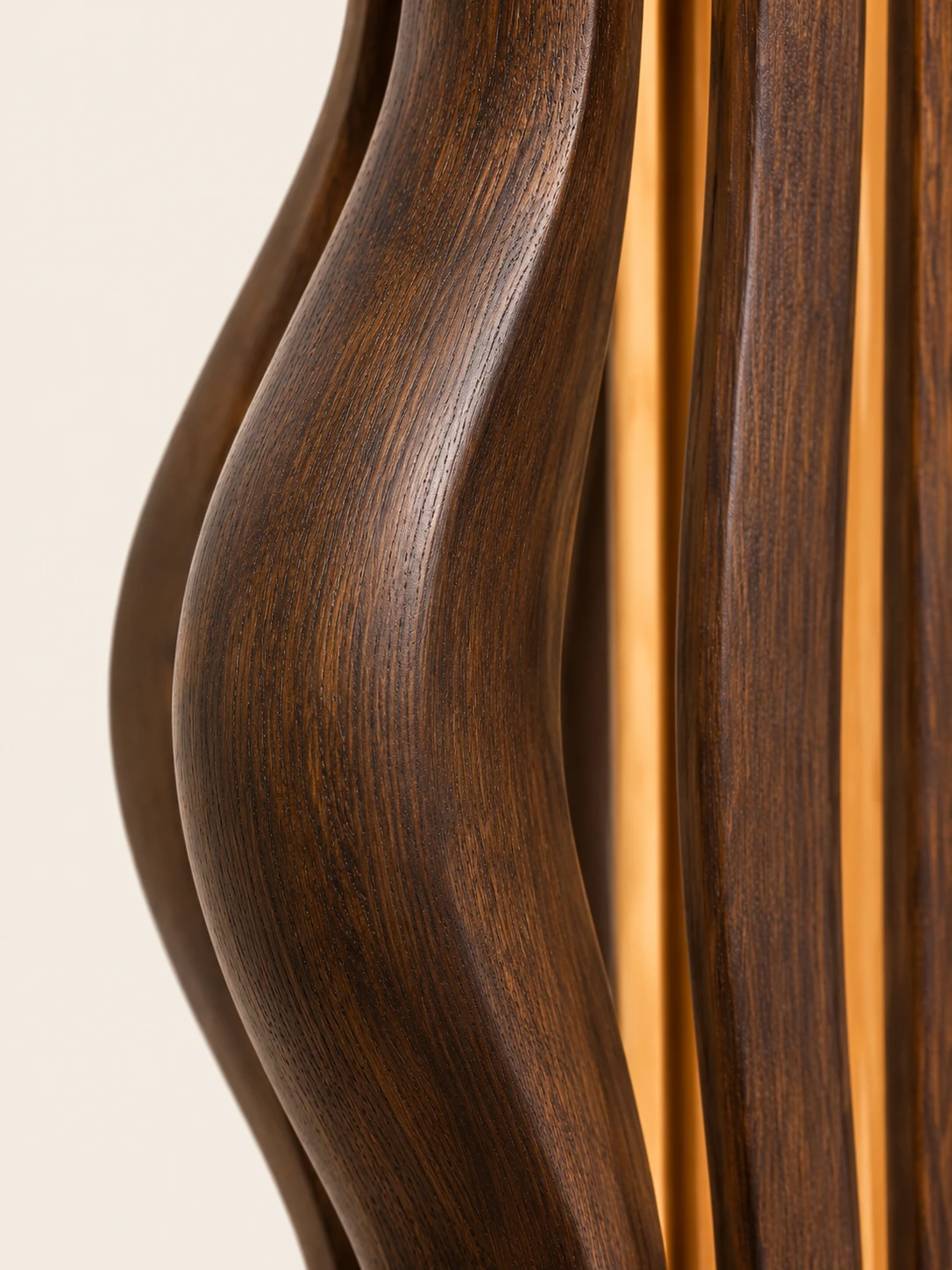
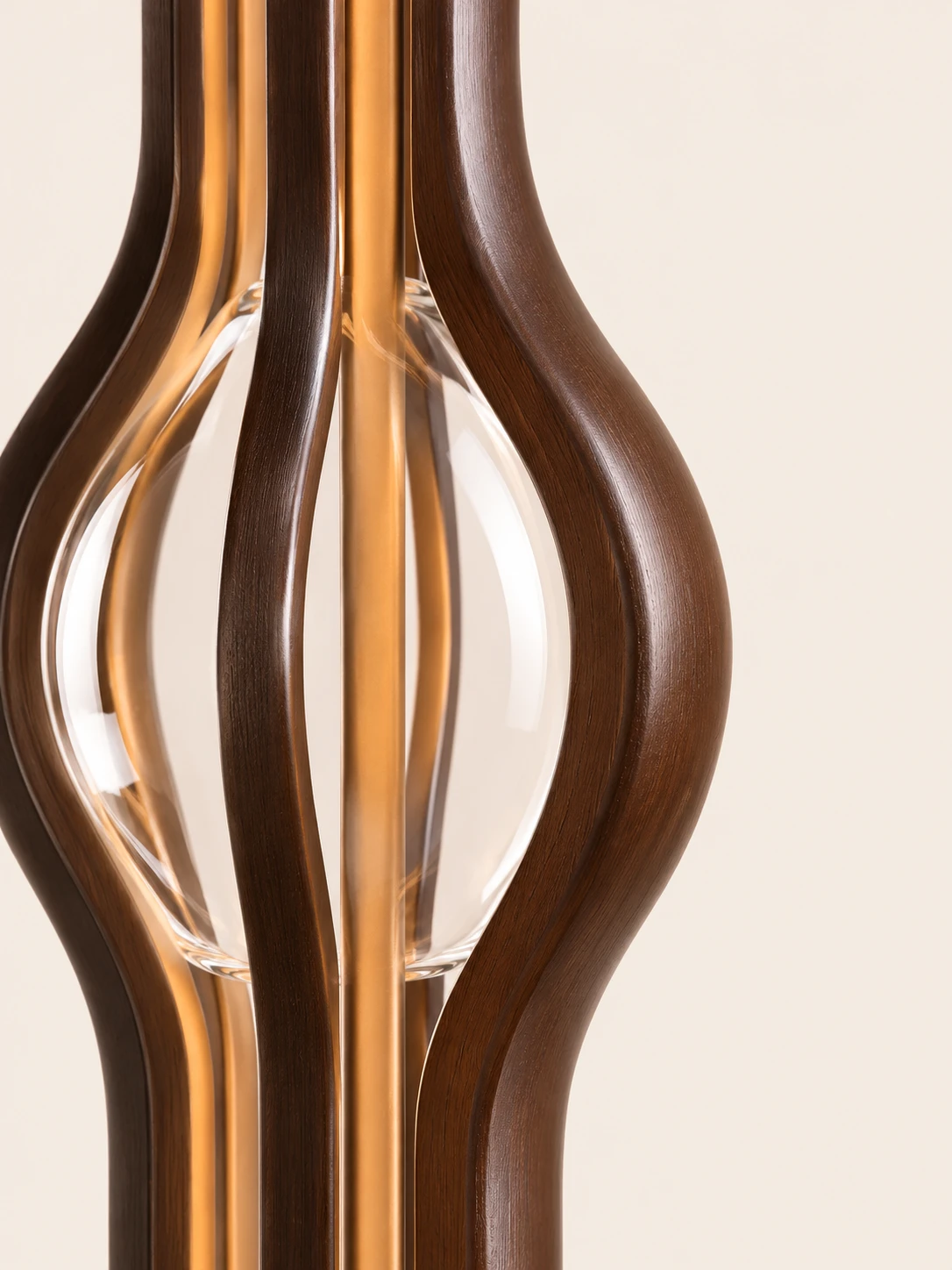
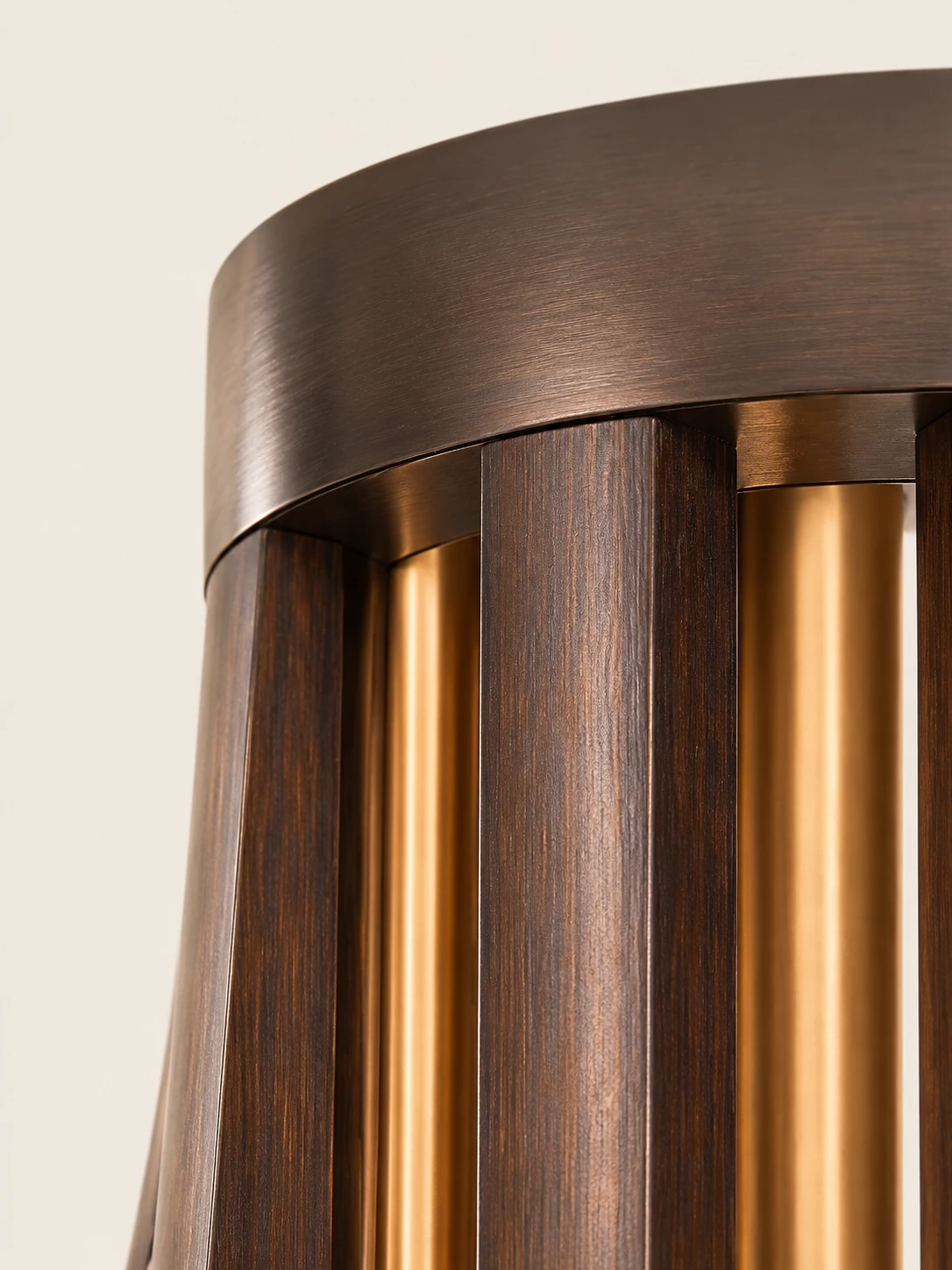
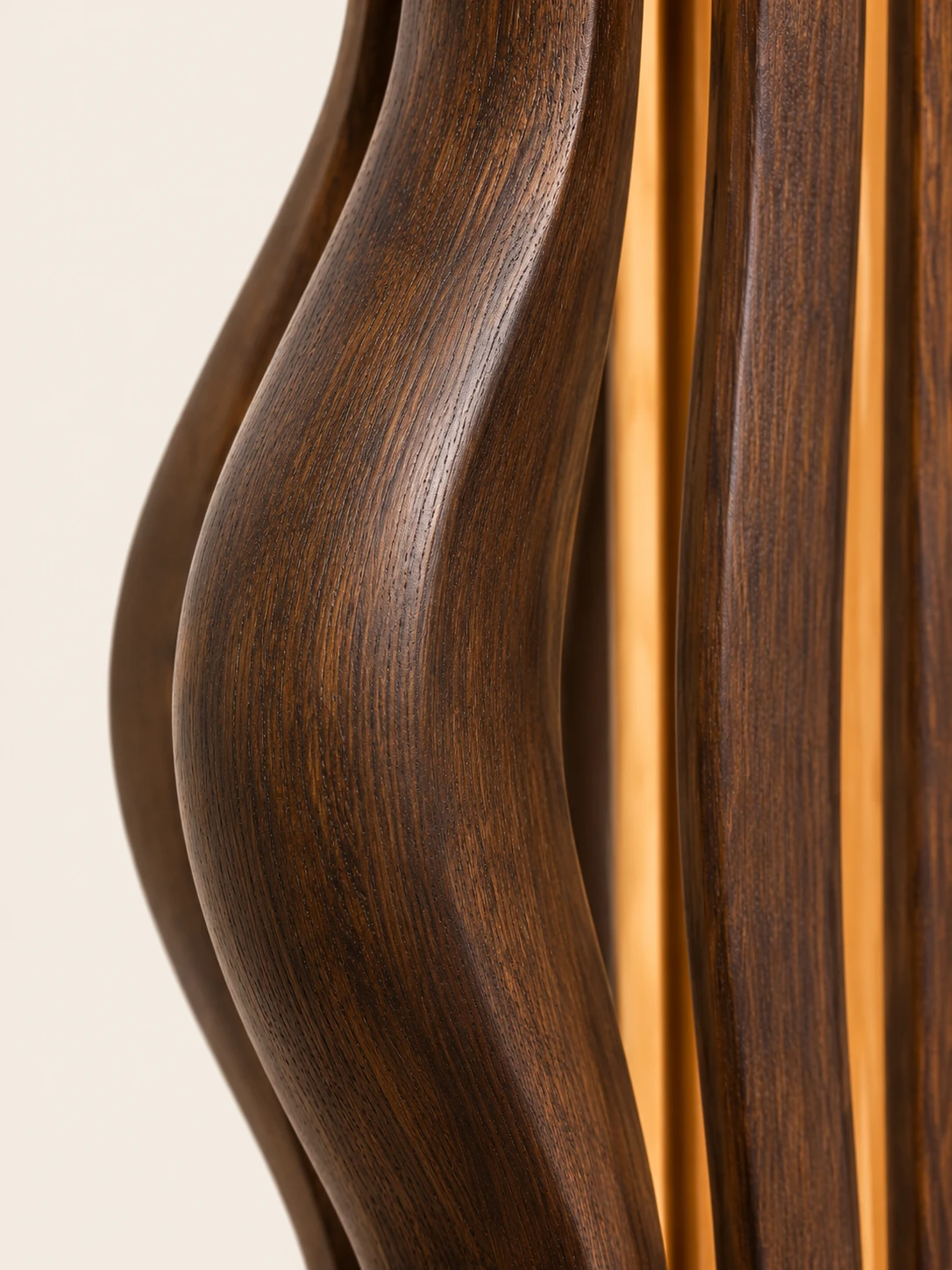
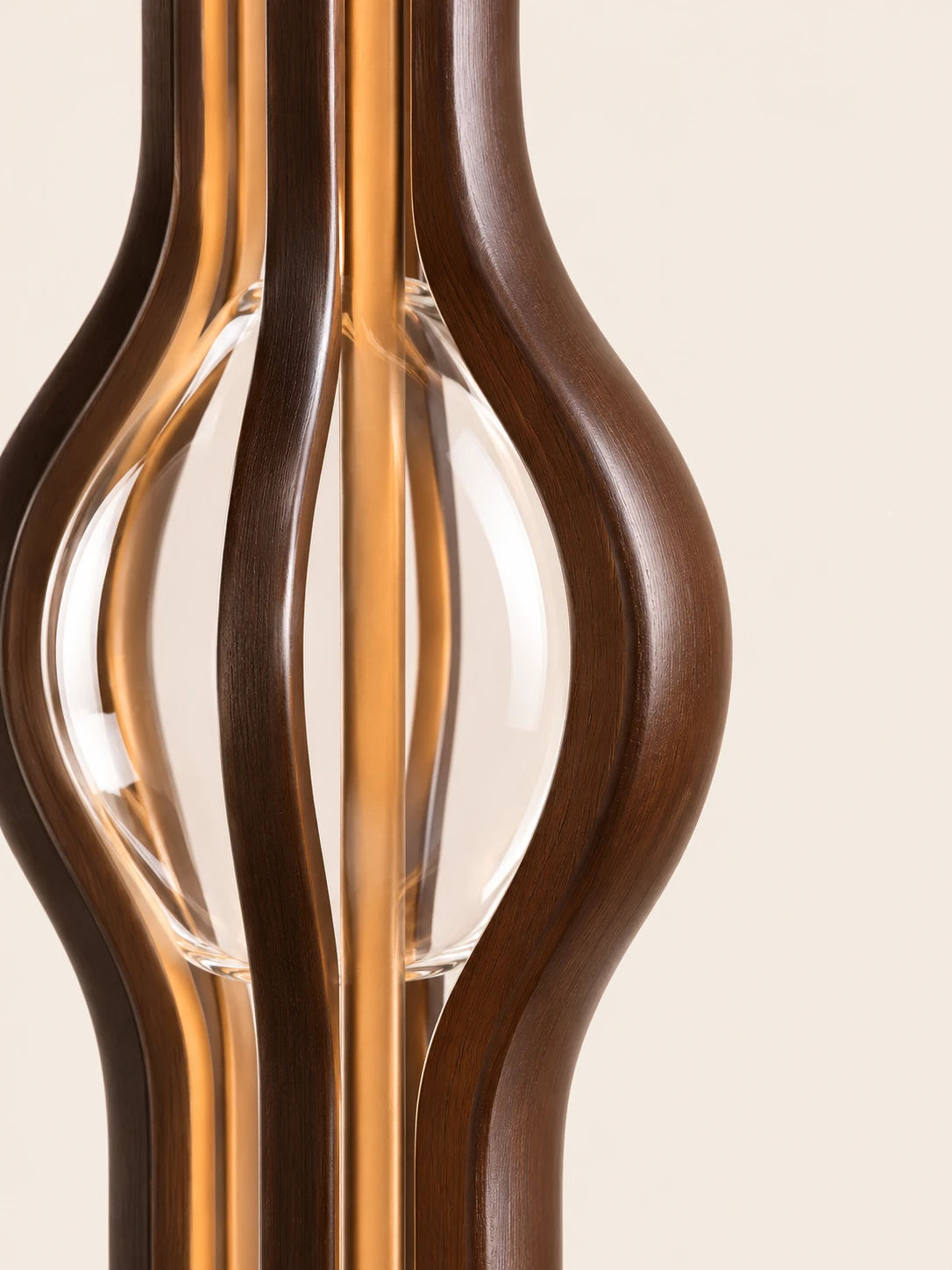
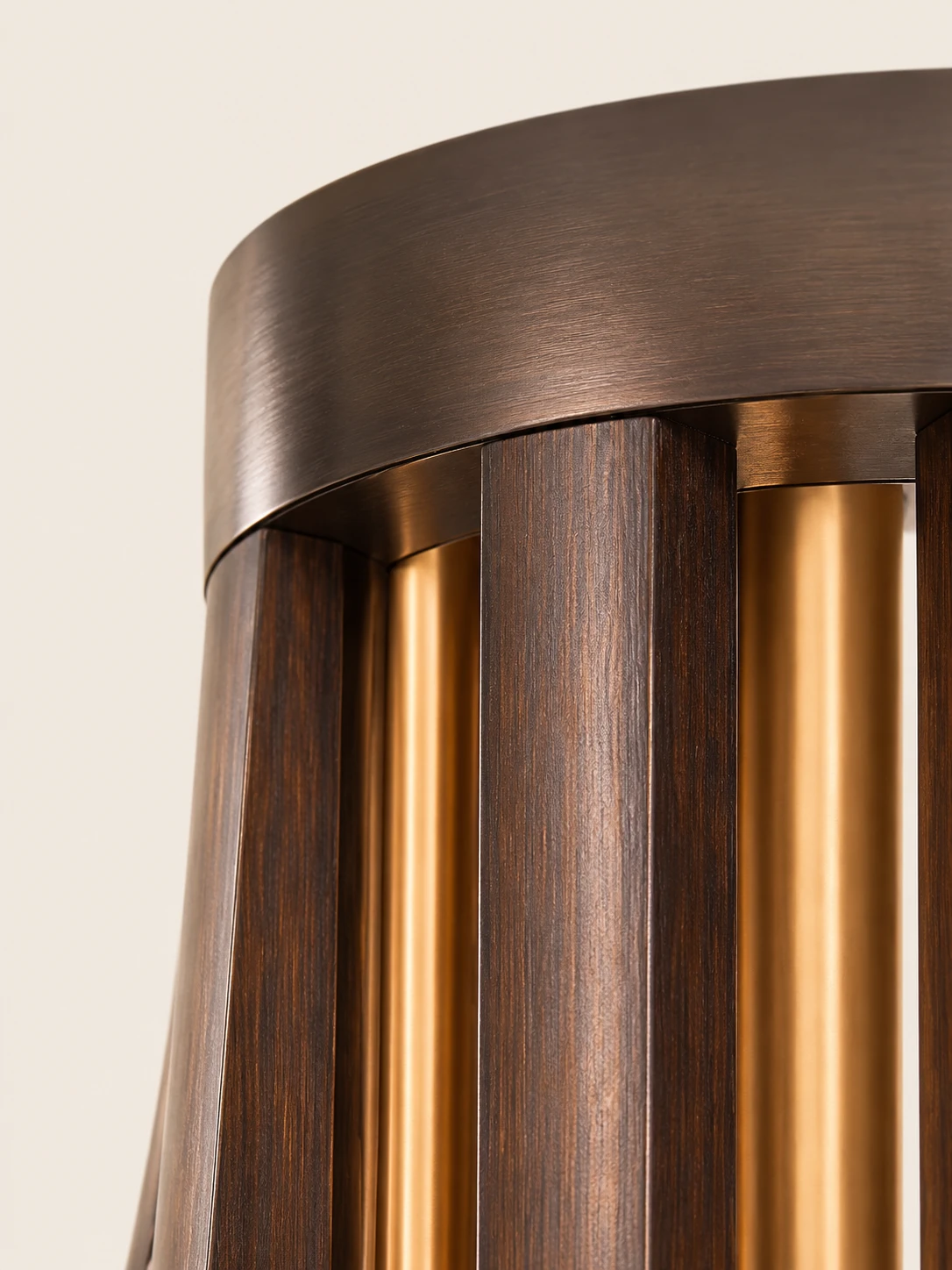
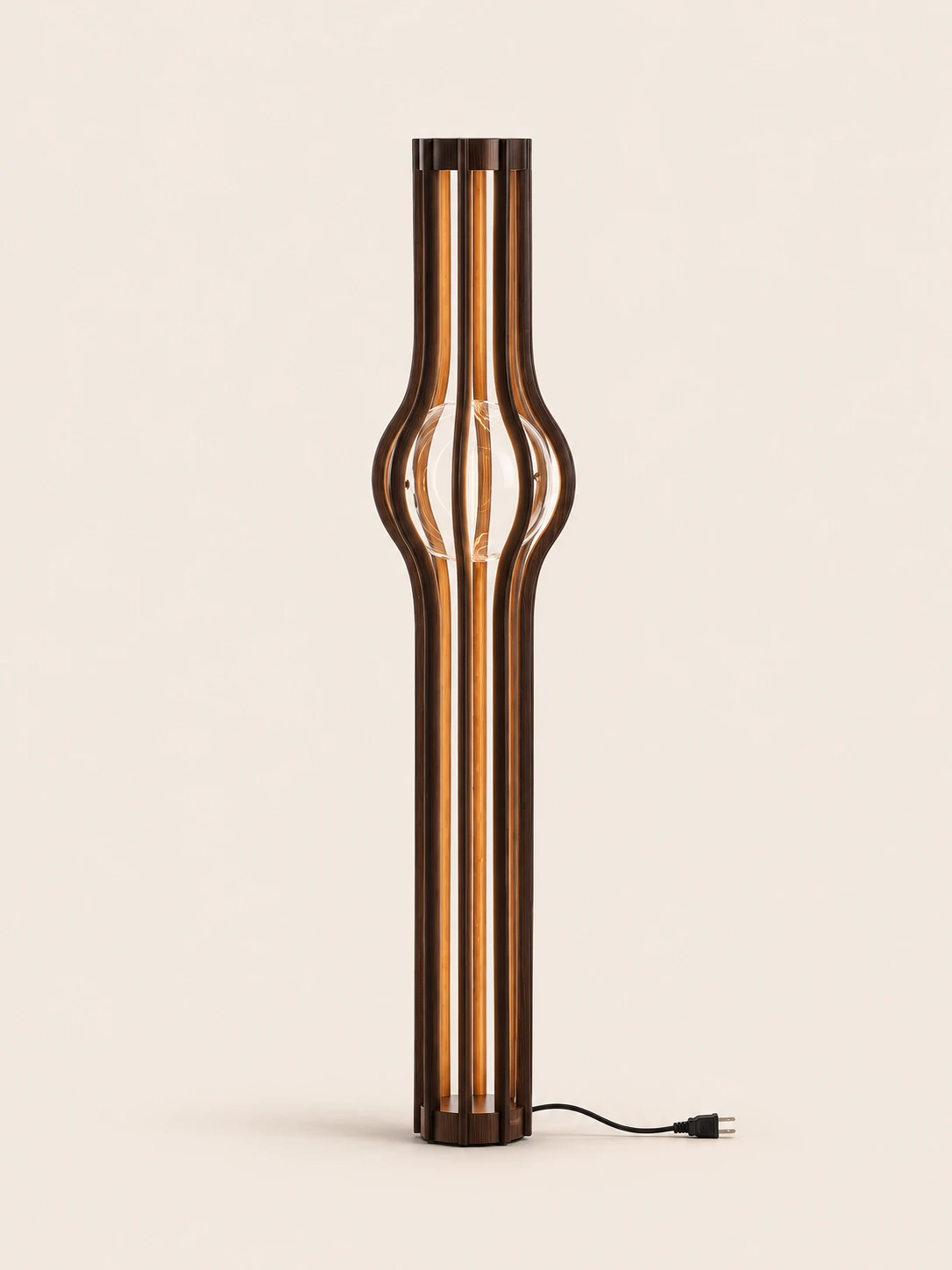
Close views show the dark wood cage, warm metal, and clear glass fitting together
01Dark wood with a strong linear grain forms a smooth, wave-like upright, while a warm gold surface shows through the narrow gap beside it02A clear rounded glass form sits within the curved wooden cage, with soft highlights on its surface and a slim gold upright running alongside it03A brushed dark metal ring rests across the tops of the vertical wooden strips, with polished gold tubes visible in the spaces between them
Sculptural Floor Lamp
A Lantern Silhouette
in Aluminum and Crystal
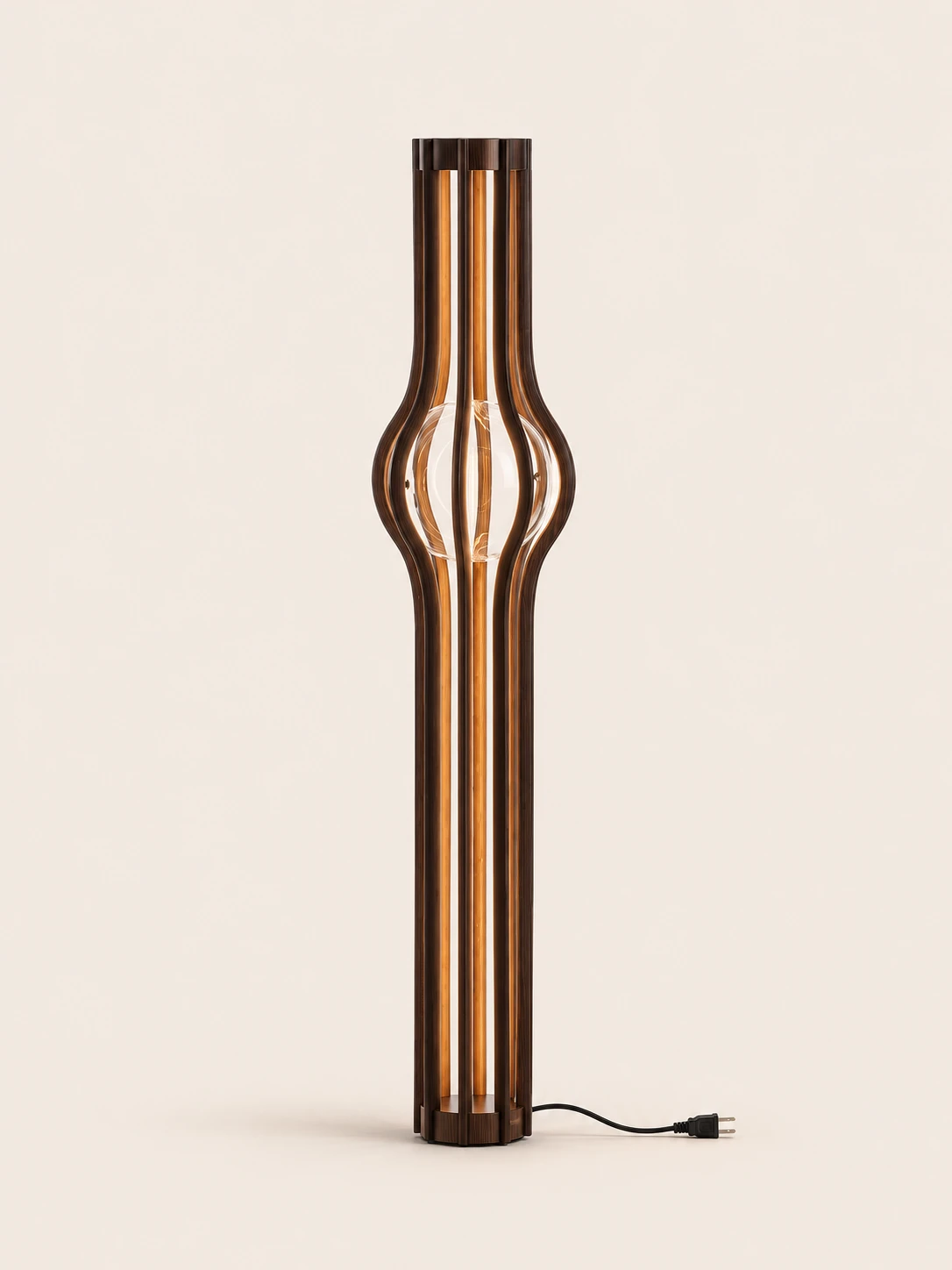
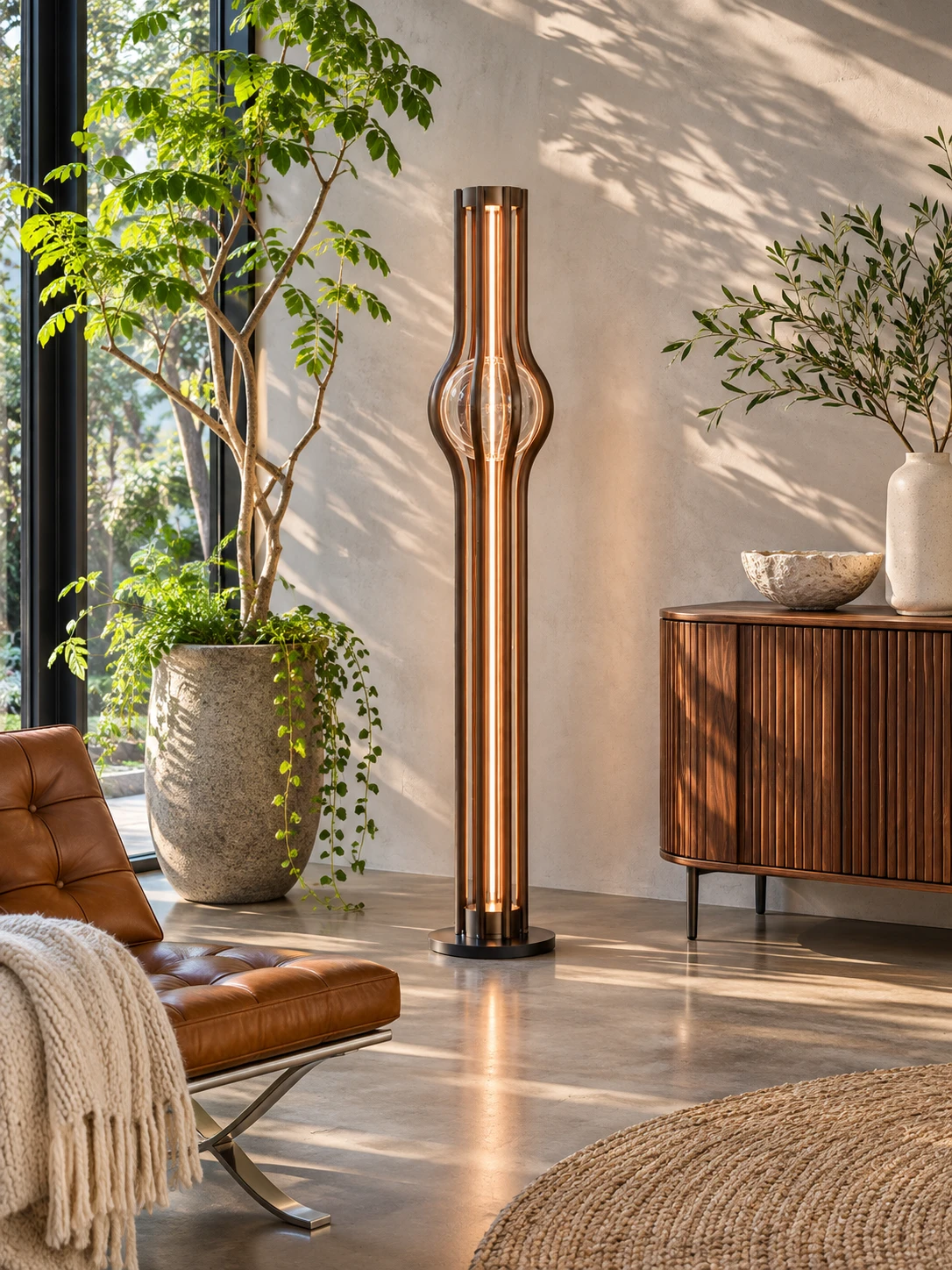
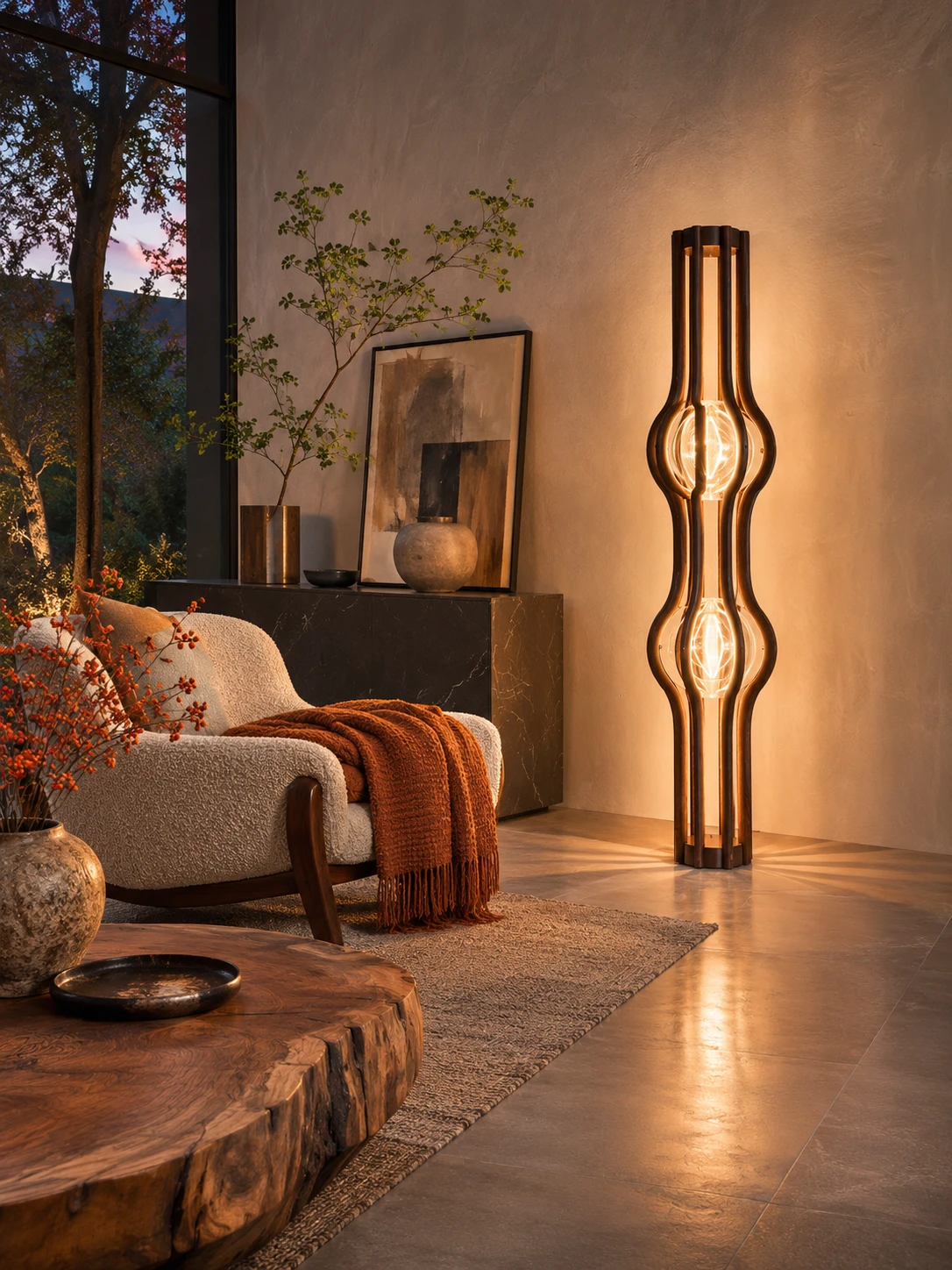
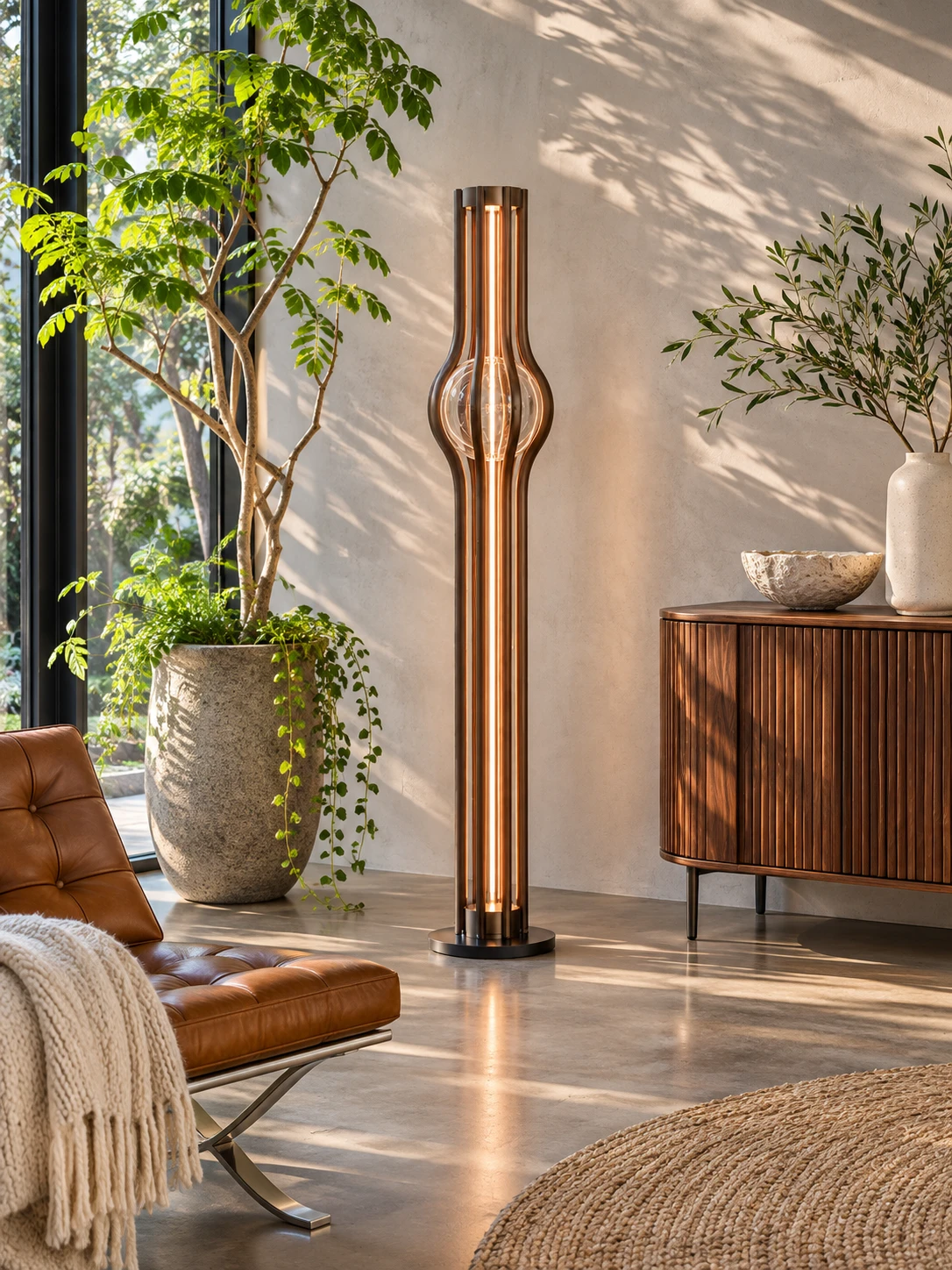
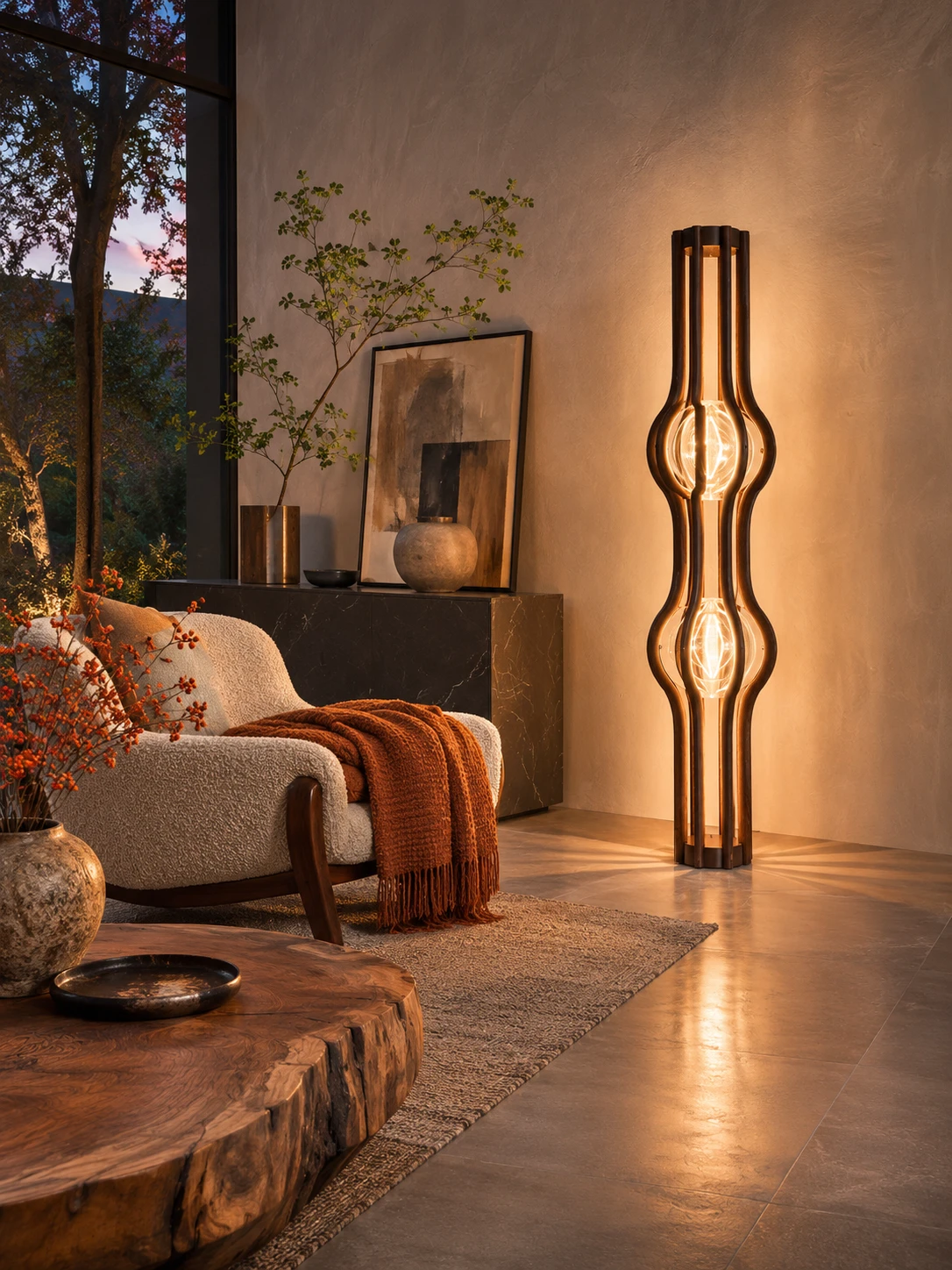
Eight curved aluminum strips rise from a circular base, swell outward around a central crystal sphere, and gather again at a matching upper cap. Concealed LED strips in the cage and upper cap play through the crystal ball. The result is a soft halo of refracted light across the floor and walls below
Highlights
Cage, Crystal, and Light
A hand-formed aluminum lantern holds a clear crystal sphere and a warm concealed LED
01
Hand-Formed Aluminum
Eight curved strips are bent and welded by hand into the lantern shape, with clean lines, no visible fasteners, and a matte black finish
02
Crystal Sphere
A single hand-blown clear crystal ball at the center captures the light and refracts it into a halo around the lamp
03
Concealed LED
LED strips run in the cage and upper cap, with no visible bulb. The default is 2700K warm white, sealed for the life of the fixture
04
Single Finish
The standard finish is matte black aluminum with a clear crystal sphere. Cage curvature and crystal clarity vary subtly from piece to piece
Specifications
Size and light
Height
Ø 39 ×: 172 cm
Diameter
× (Ø 39 × 172 cm): 15.4 ″
Height
× (Ø 39 × 172 cm): 67.7 ″
Cord length
59″ (150 cm), exiting at the base
Source
Integrated LED strips in the cage and upper cap, sealed and not user-replaceable
Color temperature
2700K warm white default; alternative color temperature on request
Dimming
Non-dimming standard; TRIAC-dimmable wiring available as a custom build and Lutron-compatible in that version
Voltage
AC 110–240V
Mounting
Plug-in floor-standing; no hardwiring required
Faux wood color · US PlugD 39cm x H 172cm / ∅ 15.4″ x H 67.7″ (warm light)
HOZO Installationsanleitung
Planen Sie Ihre Beleuchtung.
Raumweise Startwerte für Leuchtengröße, Montagehöhe, Abstand und Durchgangshöhe. Tippen Sie ein Kapitel an.
01
Esstisch
Größe und Mitte vom Tisch aus festlegen, dann die Sicht von jedem Sitz prüfen.
So messen
Tischlänge und -breite messen. Bei runden Tischen den Durchmesser nehmen.
Startbereich
Runde Leuchten: etwa 1/2 bis 2/3 der Tischbreite. Längliche Leuchten: 1/2 bis 2/3 der Tischlänge.
Platzierung
Die Leuchte über dem Tisch zentrieren, nicht zwingend über dem Raum.
Abstand
76–91 cm über der Tischplatte beginnen.
Bei langen Tischen wirken zwei kleinere Pendel oft natürlicher als eine übergroße Leuchte.
Vor dem Bohren
Eine Papierschablone an die Decke kleben und vom Türrahmen sowie sitzend prüfen.
MessenPlatte bis Unterkante
Hängehöhe76–91 cm
AusrichtenMitte des Tisches
02
Kücheninsel
Die nutzbare Insel messen und die Pendel auf der Mittellinie halten.
So messen
Nutzbare Länge und Breite der Insel messen.
Startbereich
Eine Linienleuchte: 1/2 bis 2/3 der Insel-Länge. Mehrere Pendel: erst den Durchmesser, dann die Anzahl wählen.
Platzierung
Pendelmitten gleichmäßig auf der Insel-Mittellinie.
Abstand
76–91 cm über der Arbeitsplatte. Äußere Pendel nicht an den Inselenden.
Die komplette Reihe mocken, nicht nur ein Pendel.
Vor dem Bohren
Drei Papierkreise über der Insel zeigen Abstandsprobleme schneller als ein einzelnes Muster.
MessenPlatte bis Unterkante
Hängehöhe76–91 cm
AusrichtenGleiche Mitten
03
Raummitte
Länge plus Breite ergibt den Startdurchmesser. Deckenhöhe und visuelle Schwere machen die Entscheidung fertig.
So messen
Raumlänge und -breite in Metern plus fertige Deckenhöhe.
Startbereich
Länge + Breite (m) × 8,3 ergibt einen üblichen Startdurchmesser in cm. Beispiel: 3,7 + 3,0 → ca. 56 cm.
Platzierung
Die architektonische Mitte nur nutzen, wenn sie vom Eingang und vom Möbelplan her Sinn ergibt.
Abstand
Mindestens 2,10 m lichte Höhe unter dem tiefsten Punkt im Laufbereich.