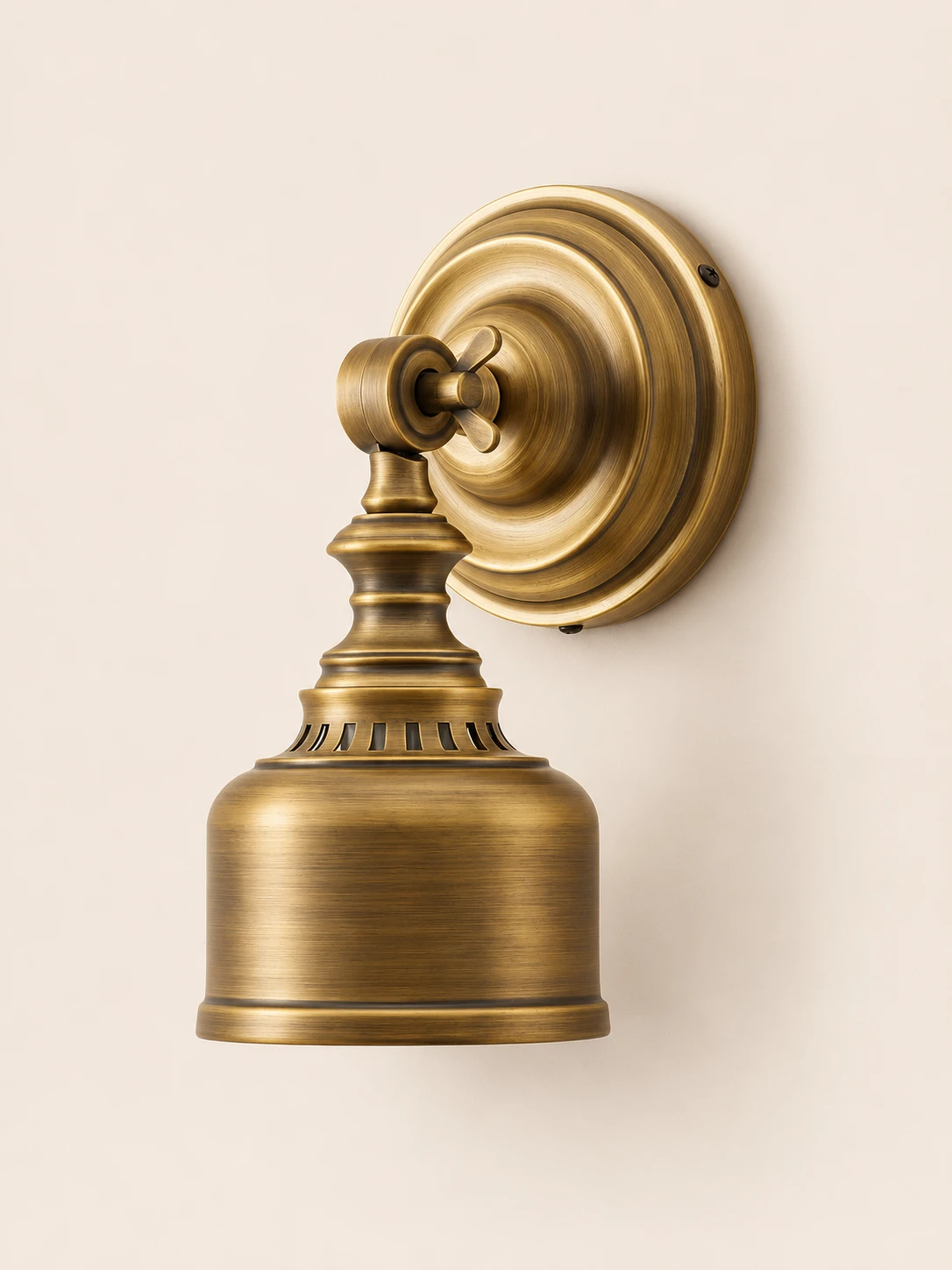
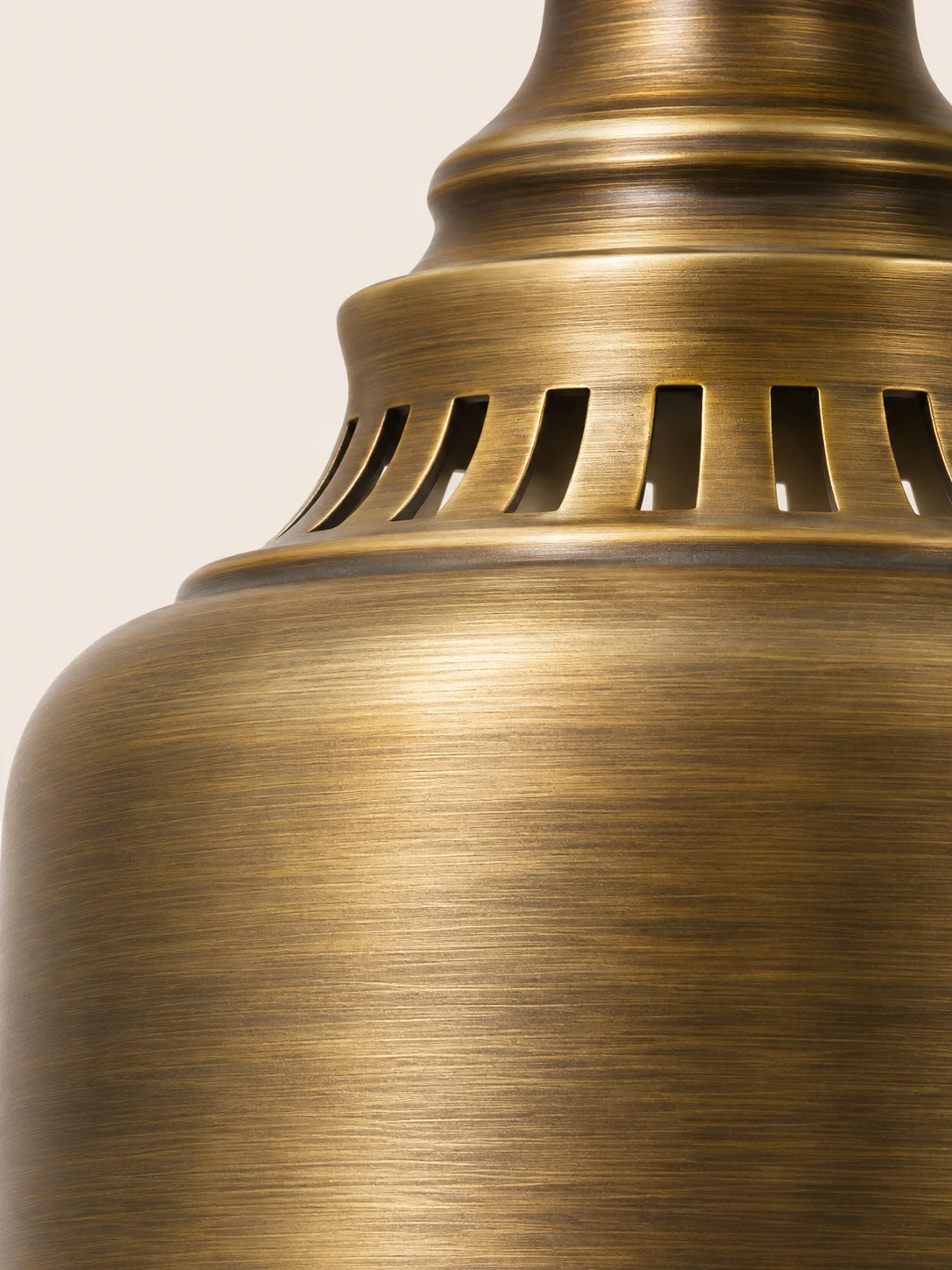
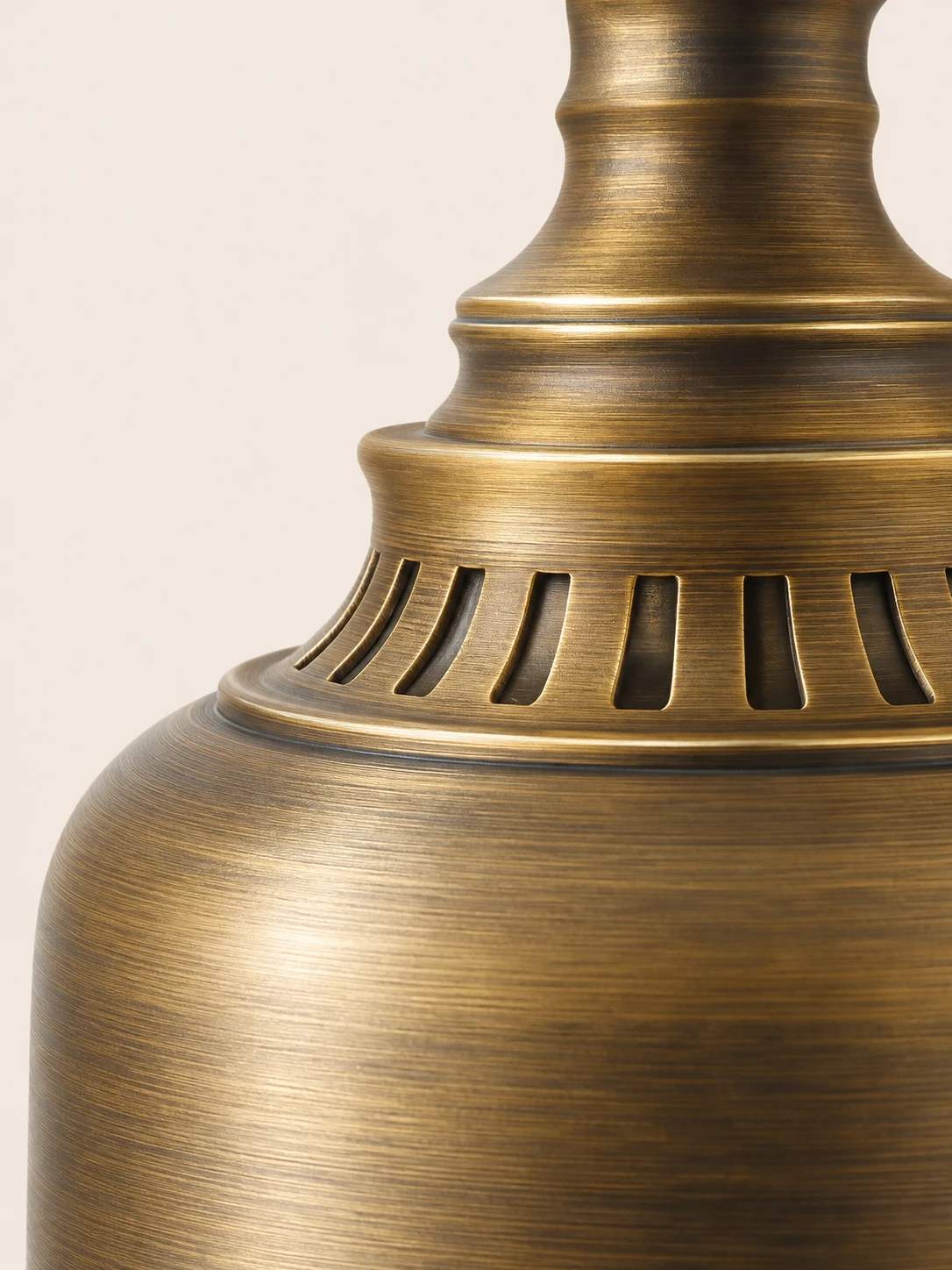
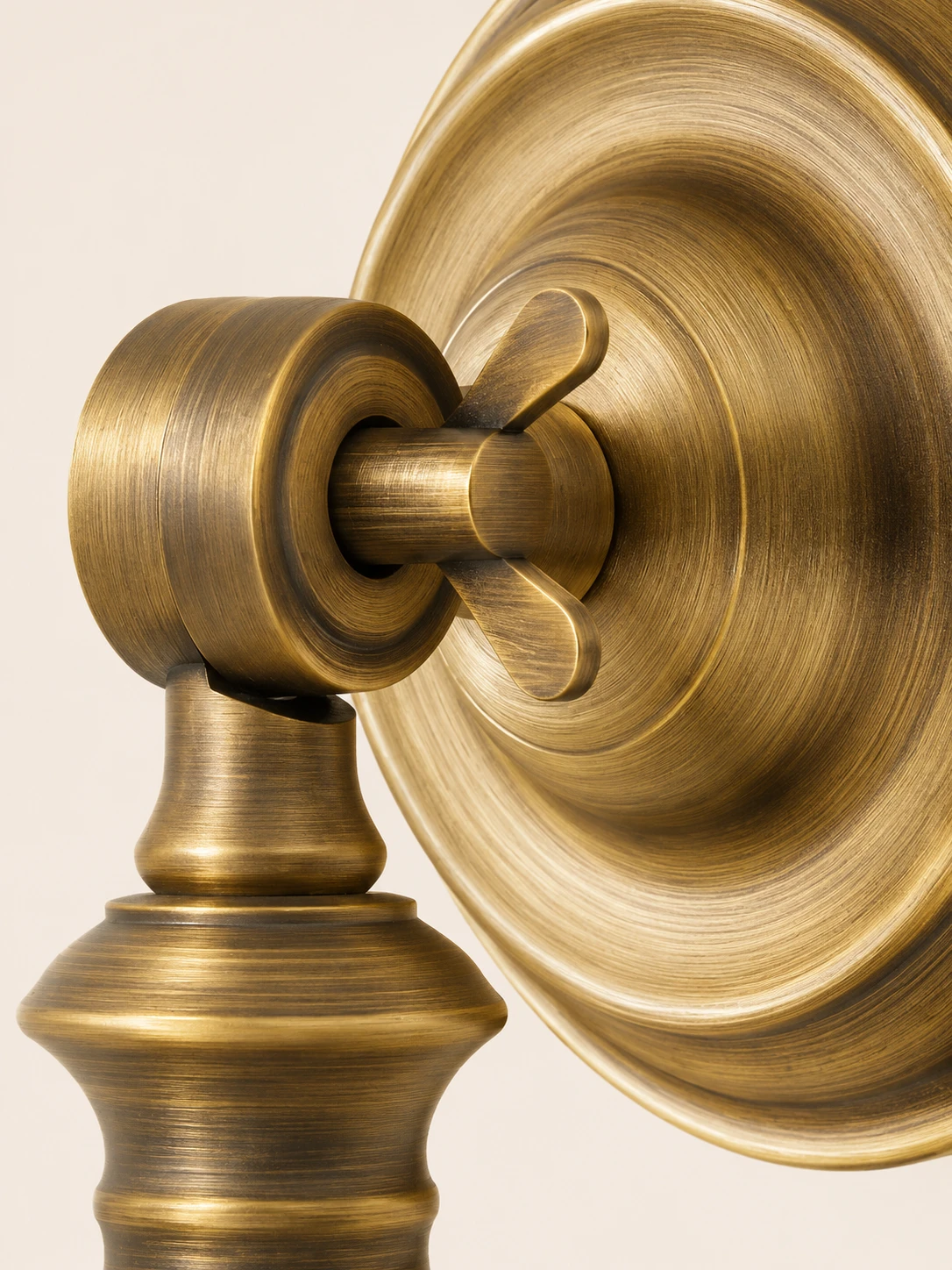
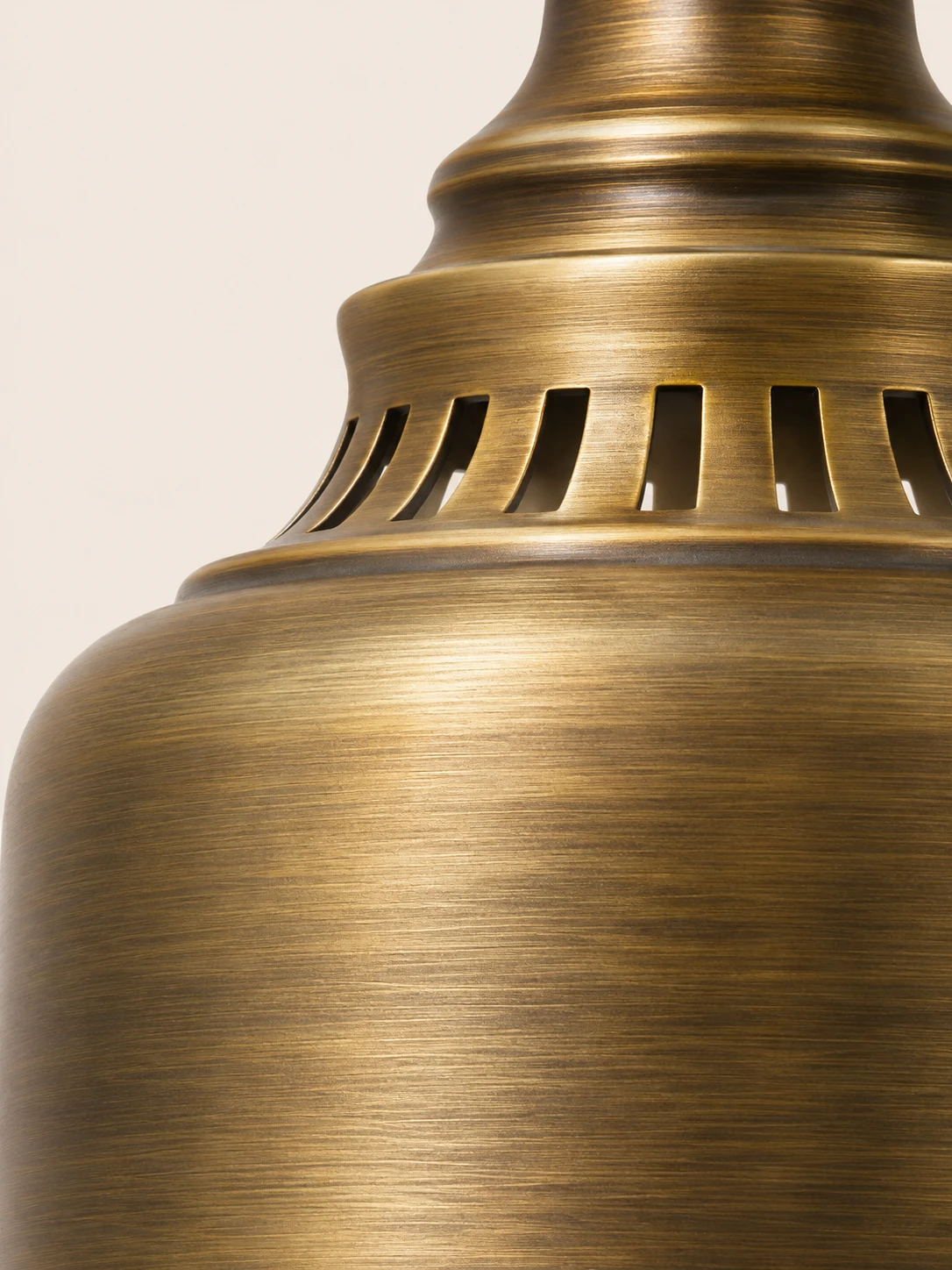
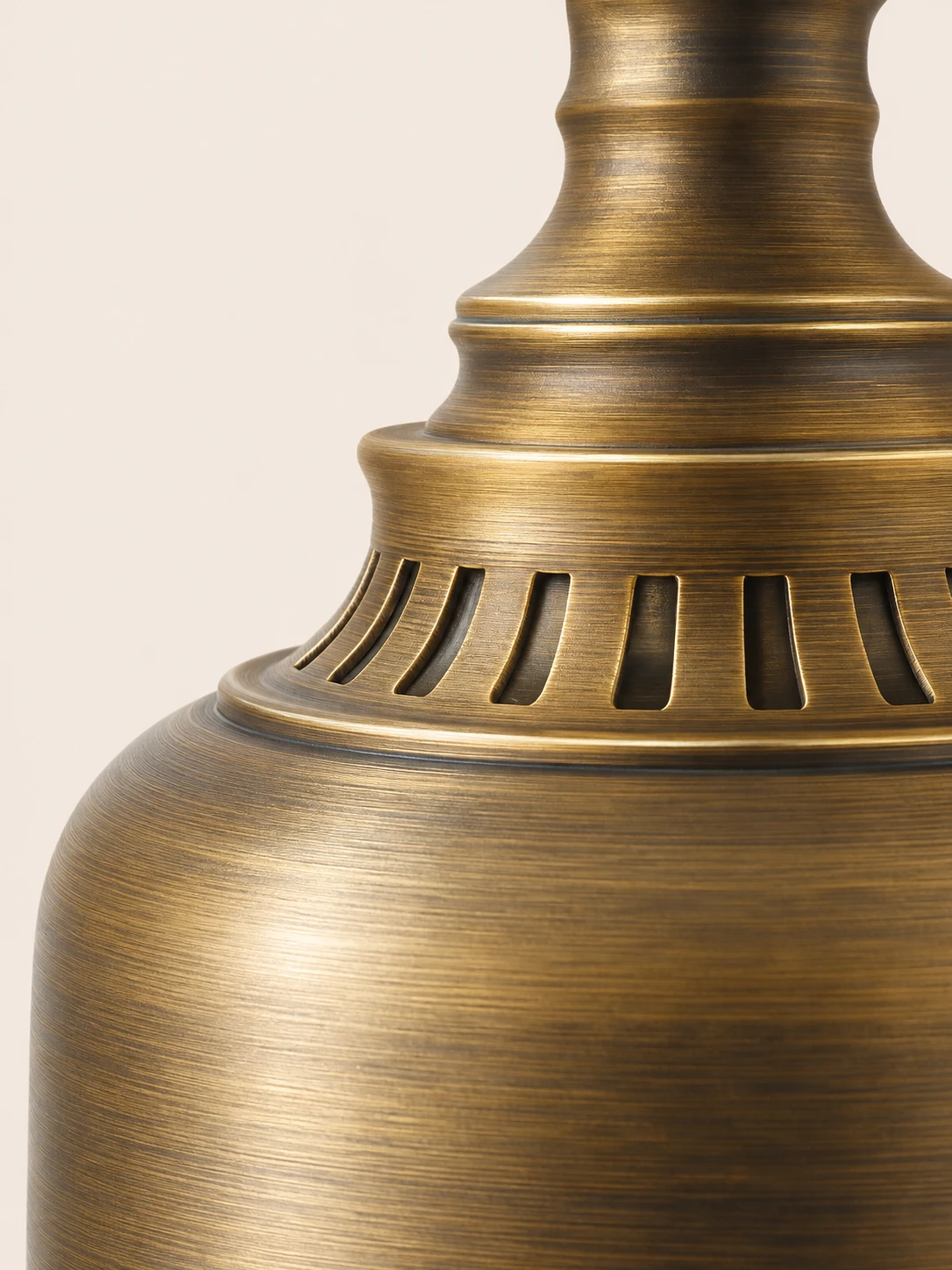
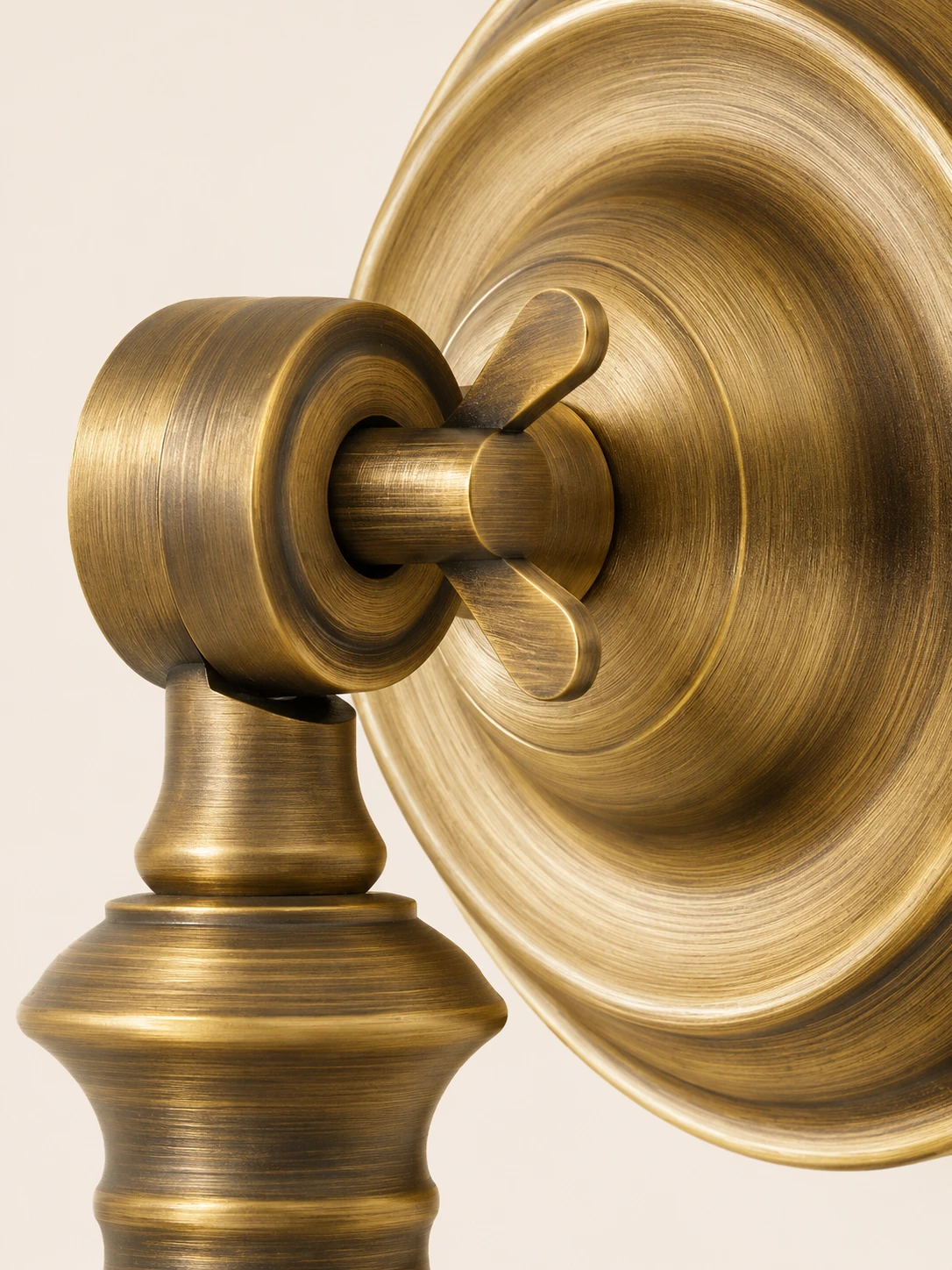
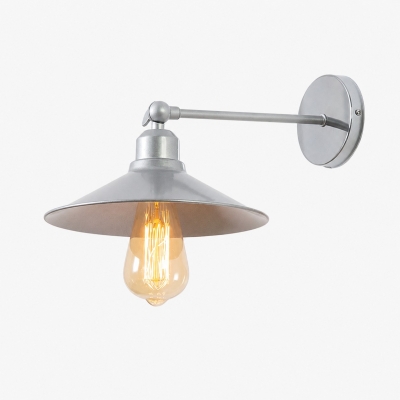
Three tight views trace the lamp’s vented metalwork, turned surfaces, and swivel joint
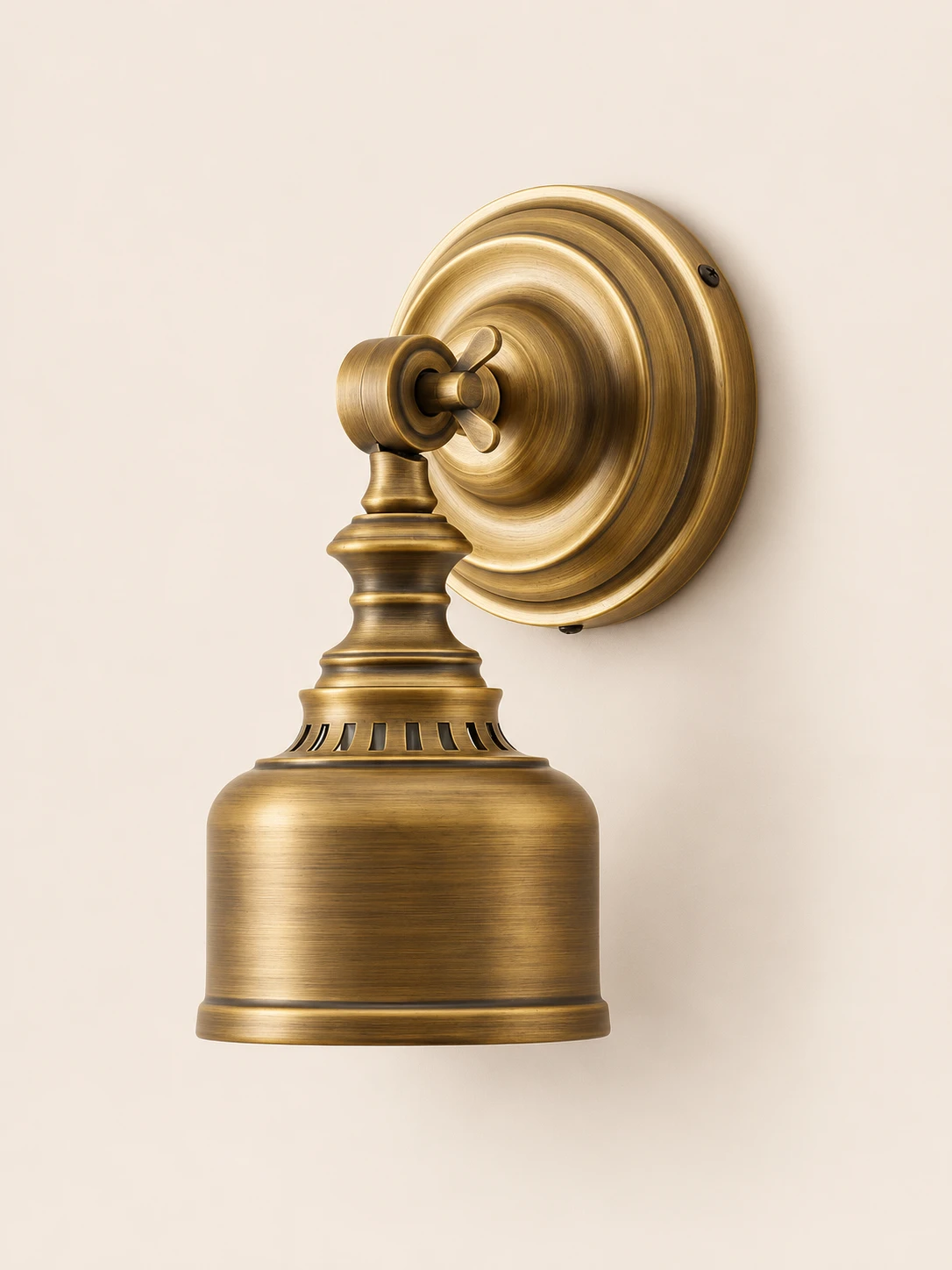
01A broad brushed-brass curve rises to a dark seam and a flared collar pierced by a row of narrow rectangular openings, with stepped rings above02The same warm finish continues from a rounded body through the slotted flare and stacked moldings into a narrower neck, the horizontal brush marks catching a soft highlight03A round knuckle and central pin form the swivel beside a small cross-shaped fitting, backed by a circular plate of concentric rings and a turned stem below
Compact wall sconce
Antique brass,
close to the wall
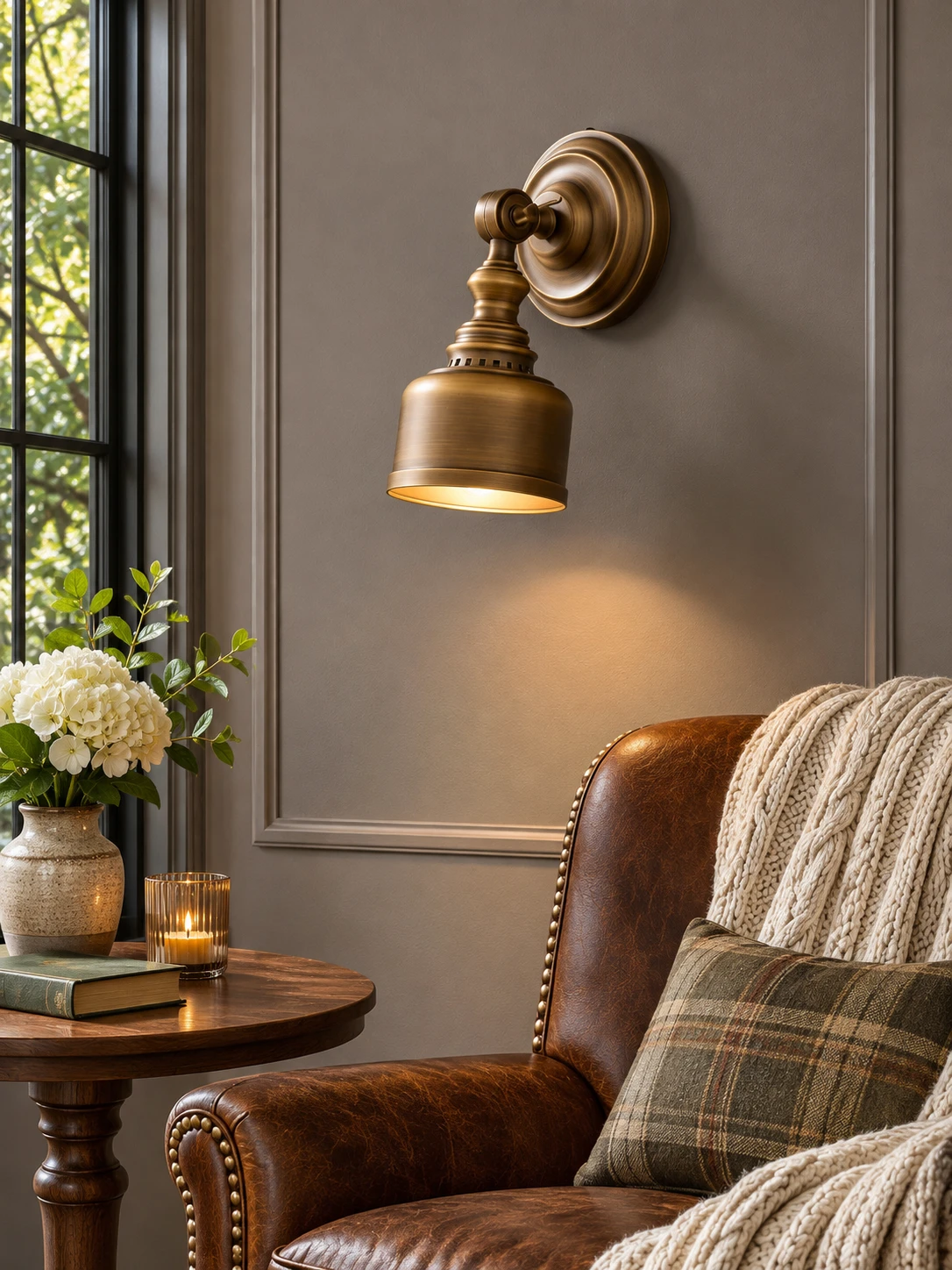
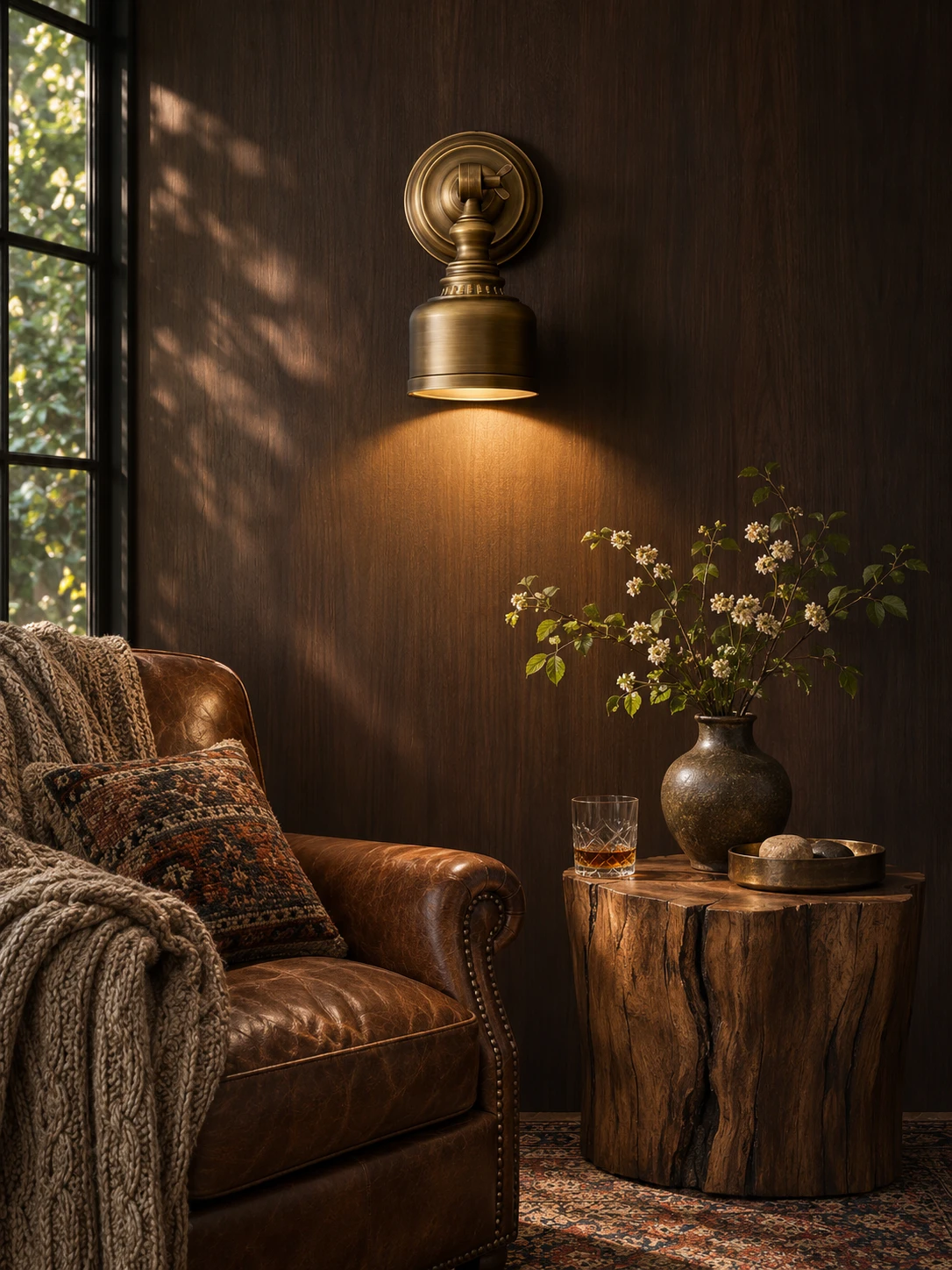
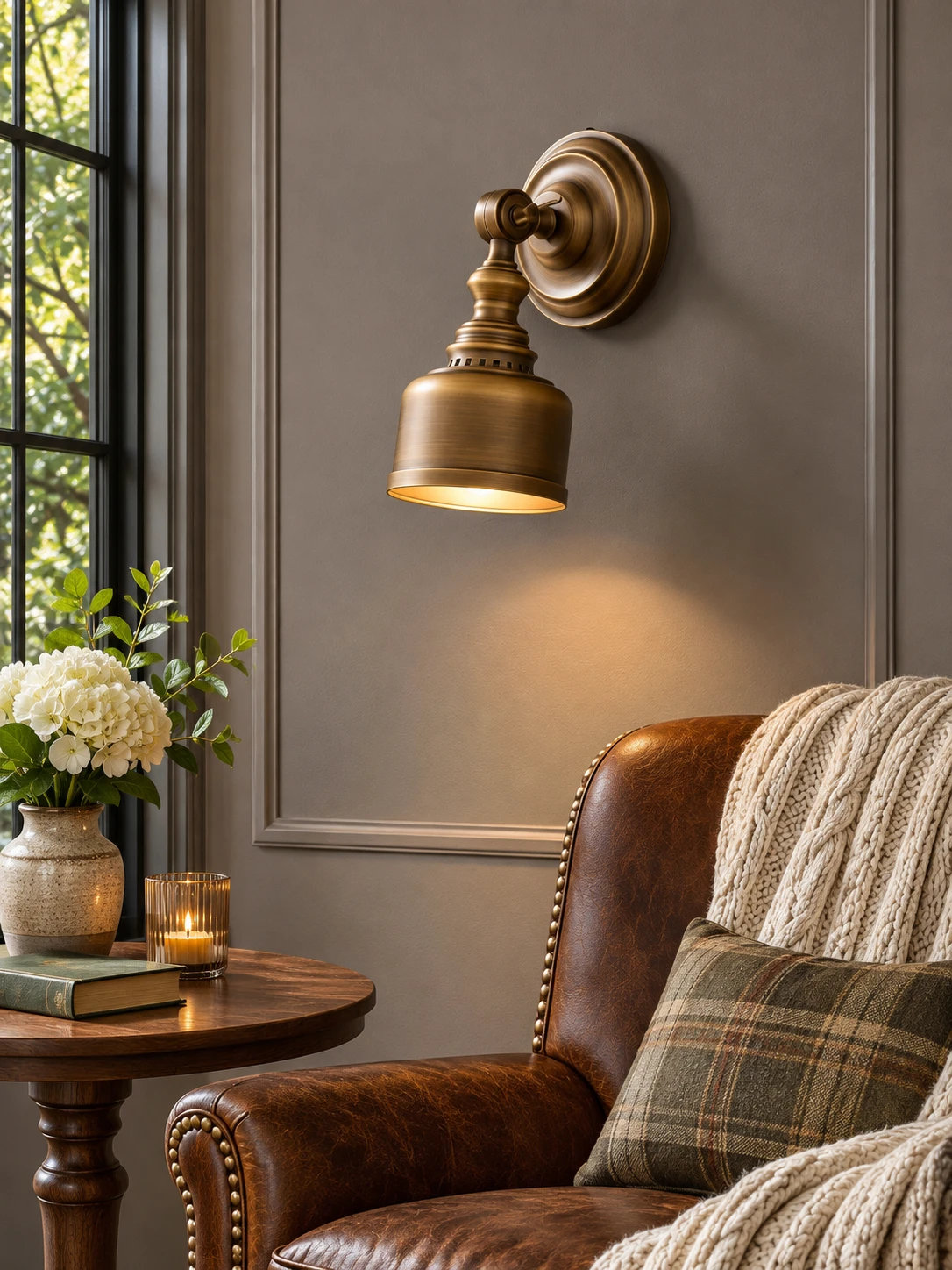
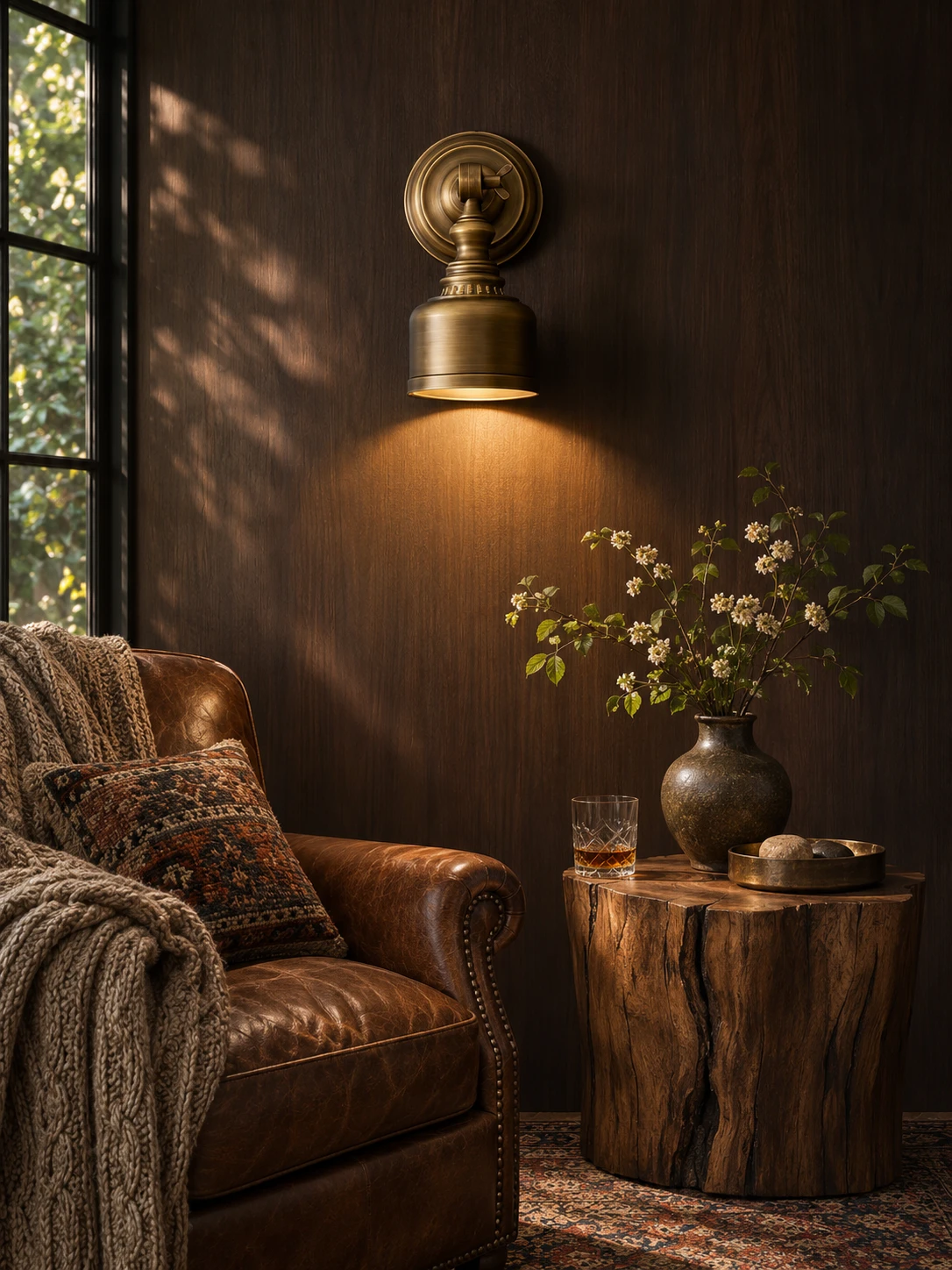
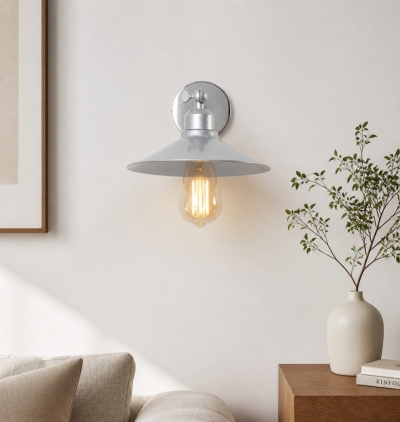
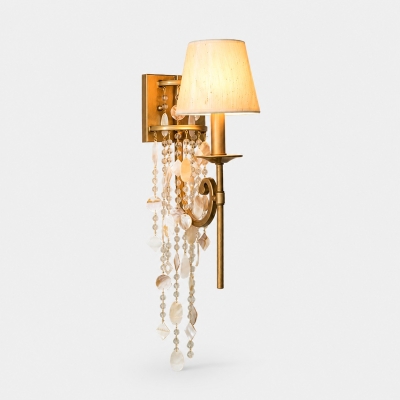
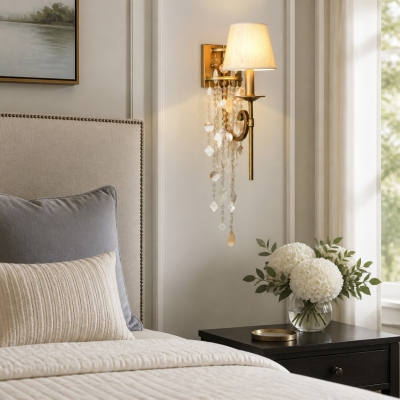
A compact vintage wall sconce in solid brass pairs a turned circular backplate and swivel pivot with a cylindrical shade held close to the wall. The shade hangs at a slight downward angle, casting light onto the wall and the floor below. Hand-aged antique brass and turned details give it a quiet workshop presence without a projecting arm
Highlights
Small footprint, turned brass
A direct-mount sconce keeps the shade near the wall while the brass, finish, and candelabra socket stay simple to live with
01
Solid brass build
Solid brass forms the body and shade, with hand-turned details on the backplate and shade that can take on a natural patina over years of use
02
Compact wall profile
A 12.5 cm backplate and 24.5 cm total height keep the fixture small, so the shade can sit close on narrow hallways and other tight walls
03
Candelabra light
An E12 or E14 candelabra socket takes a user-replaceable bulb, sold separately, with warm white around 3000K and a maximum of 25W recommended
04
Burnished brass finish
Lacquered burnished brass is hand-aged to a warm tone, with darker recesses in the turned details that suit cream walls, brick, oak, and workshop interiors
Specifications
Size and light
Backplate width
∅ 12.5 cm / 4.9"
Total height
24.5 cm / 9.6"
Socket
E12 / E14 candelabra
Bulb
Not included; user-replaceable
Recommended bulb
LED candelabra or vintage Edison filament, max 25W
Color temperature
Set by the bulb; warm white 3000K recommended
Dimming
With a dimmable bulb and TRIAC dimmer
Voltage
AC 110–240V
Timarron Wall Lamp
HOZO Installationsanleitung
Planen Sie Ihre Beleuchtung.
Raumweise Startwerte für Leuchtengröße, Montagehöhe, Abstand und Durchgangshöhe. Tippen Sie ein Kapitel an.
01
Esstisch
Größe und Mitte vom Tisch aus festlegen, dann die Sicht von jedem Sitz prüfen.
So messen
Tischlänge und -breite messen. Bei runden Tischen den Durchmesser nehmen.
Startbereich
Runde Leuchten: etwa 1/2 bis 2/3 der Tischbreite. Längliche Leuchten: 1/2 bis 2/3 der Tischlänge.
Platzierung
Die Leuchte über dem Tisch zentrieren, nicht zwingend über dem Raum.
Abstand
76–91 cm über der Tischplatte beginnen.
Bei langen Tischen wirken zwei kleinere Pendel oft natürlicher als eine übergroße Leuchte.
Vor dem Bohren
Eine Papierschablone an die Decke kleben und vom Türrahmen sowie sitzend prüfen.
MessenPlatte bis Unterkante
Hängehöhe76–91 cm
AusrichtenMitte des Tisches
02
Kücheninsel
Die nutzbare Insel messen und die Pendel auf der Mittellinie halten.
So messen
Nutzbare Länge und Breite der Insel messen.
Startbereich
Eine Linienleuchte: 1/2 bis 2/3 der Insel-Länge. Mehrere Pendel: erst den Durchmesser, dann die Anzahl wählen.
Platzierung
Pendelmitten gleichmäßig auf der Insel-Mittellinie.
Abstand
76–91 cm über der Arbeitsplatte. Äußere Pendel nicht an den Inselenden.
Die komplette Reihe mocken, nicht nur ein Pendel.
Vor dem Bohren
Drei Papierkreise über der Insel zeigen Abstandsprobleme schneller als ein einzelnes Muster.
MessenPlatte bis Unterkante
Hängehöhe76–91 cm
AusrichtenGleiche Mitten
03
Raummitte
Länge plus Breite ergibt den Startdurchmesser. Deckenhöhe und visuelle Schwere machen die Entscheidung fertig.
So messen
Raumlänge und -breite in Metern plus fertige Deckenhöhe.
Startbereich
Länge + Breite (m) × 8,3 ergibt einen üblichen Startdurchmesser in cm. Beispiel: 3,7 + 3,0 → ca. 56 cm.
Platzierung
Die architektonische Mitte nur nutzen, wenn sie vom Eingang und vom Möbelplan her Sinn ergibt.
Abstand
Mindestens 2,10 m lichte Höhe unter dem tiefsten Punkt im Laufbereich.